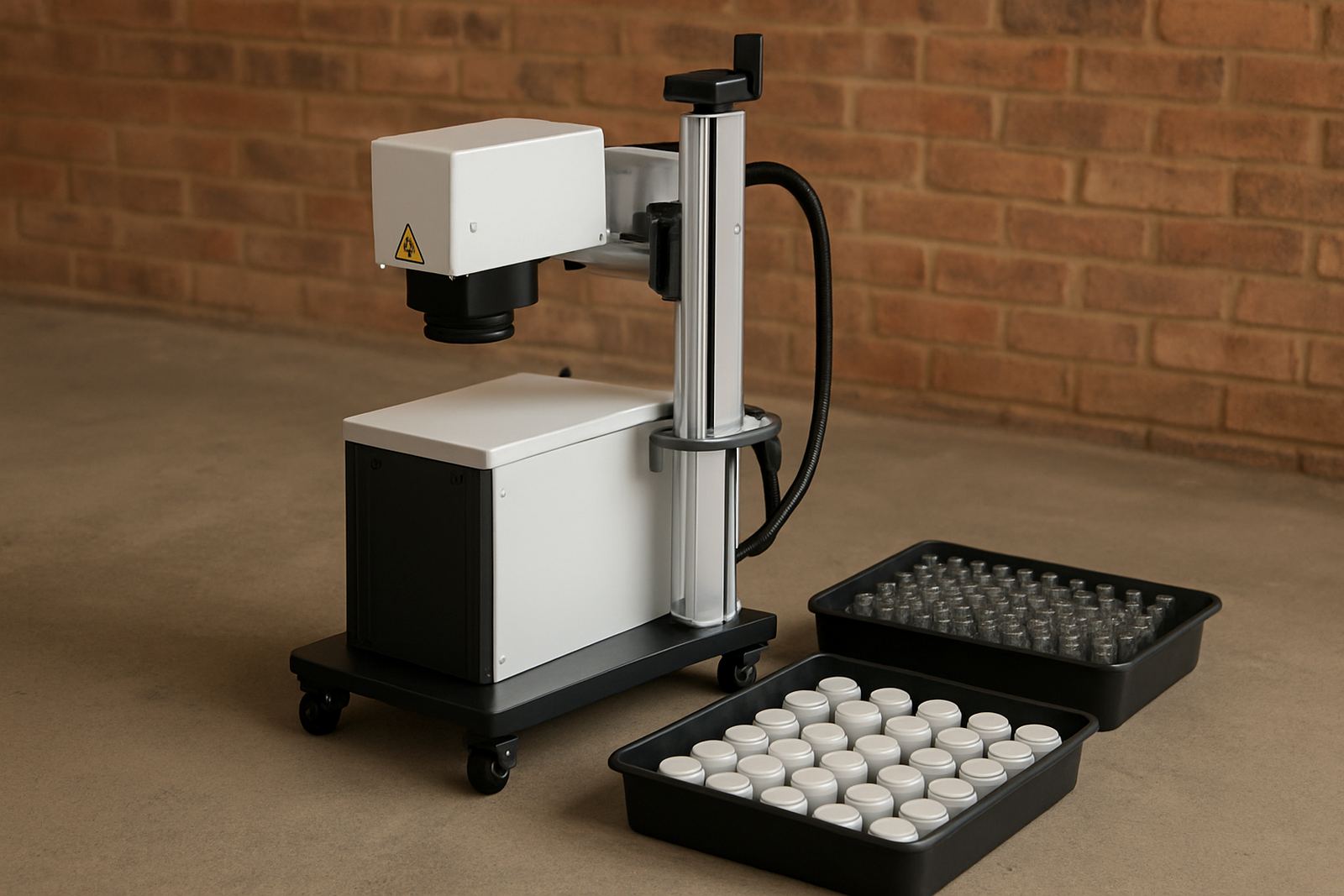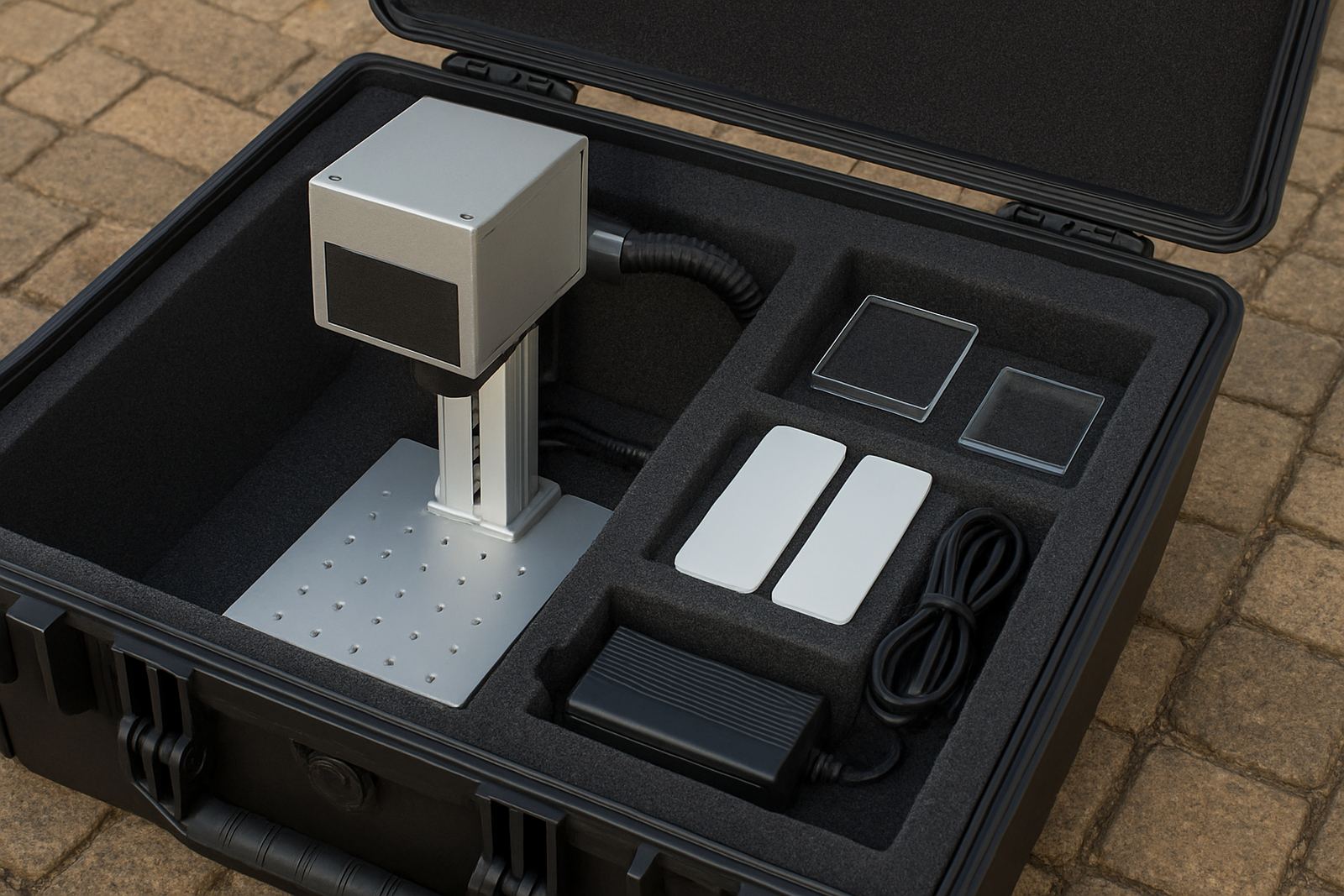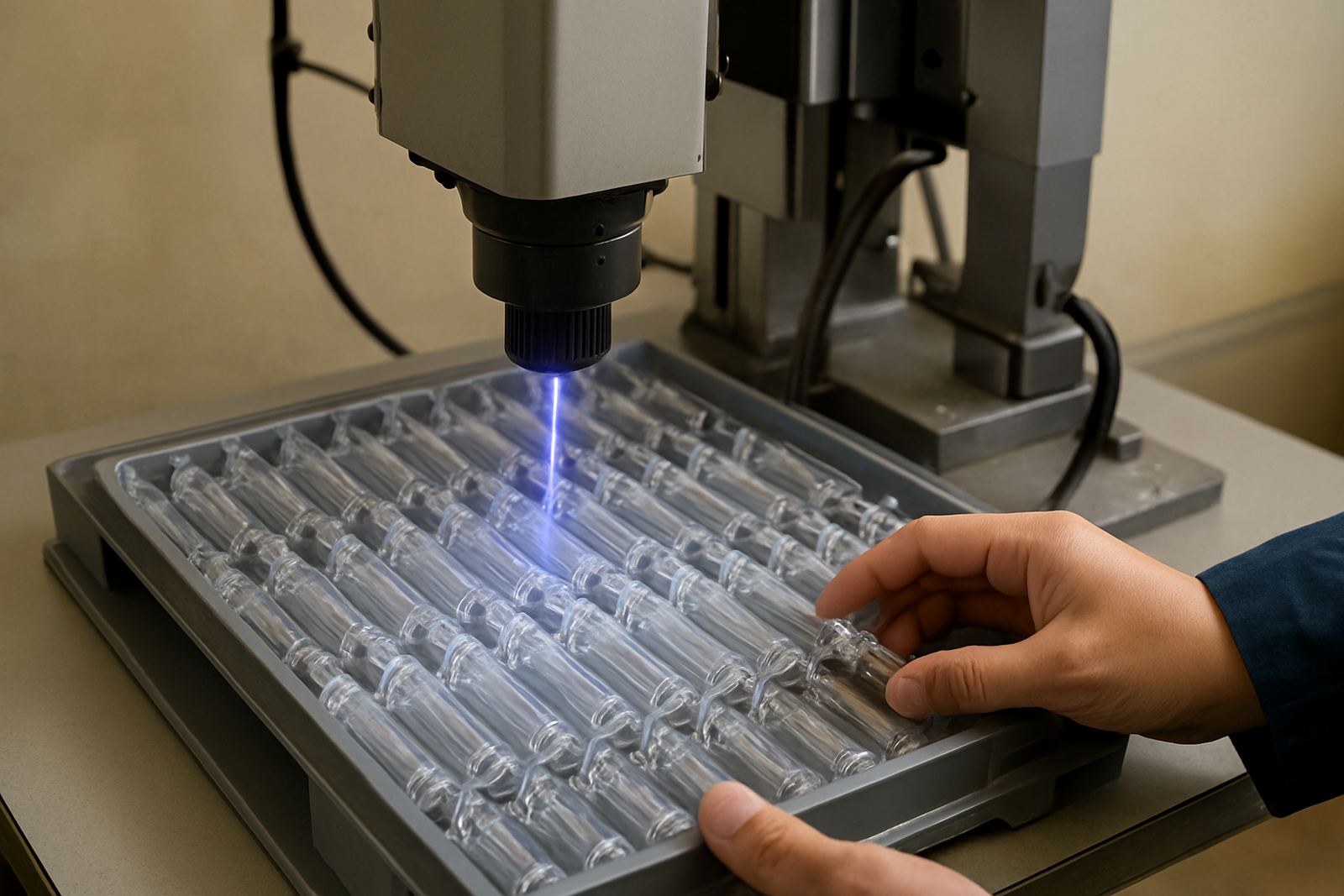
Tray-loaded marking for repeat parts
The Tray Feed Marker is a practical UV laser marking system for products that arrive in trays, pockets or carriers and must be marked one after the other with consistent positioning. It is commonly used where the same component is marked in batches, such as caps, jars, cosmetic containers, medical parts, appliance plastics and glass items that must carry a logo, code or production detail. Because the product stays supported in a tray, the mark stays accurate and the risk of handling damage is kept low.
UV laser marking is especially useful on clear, coloured and coated plastics as well as glass, where ink can smear and labels can lift in humid conditions. The mark is permanent, fine and clean, which makes it suitable for branding, traceability and regulatory coding. For businesses in Jet Park, Boksburg, Germiston and Kempton Park, this is a neat option when the product mix is steady and the batch repeat is high.
- Permanent marking on glass and plastics
- Best for repeat batch work in trays or carriers
- Suitable for logos, serials, dates, barcodes and small text
- Helps reduce smudging, peeling and rework
Typical sizes, tray layouts and marking options
Tray feed systems are usually configured around the part size and the number of items in each tray. The marking field can be set up for single items, multi-cavity trays or indexed layouts where each part stops under the beam in a fixed position. That makes it easier to keep the mark in the same spot on every cycle, even when the tray has many pieces. Where space is tight, we can work with smaller footprints, while larger cells can be set up for wider trays and more output per loading cycle.
On the marking side, the system can handle a range of data and artwork. This includes batch numbers, expiry dates, QR codes, 1D barcodes, small logos and neat text. For some plastics, a surface contrast mark is preferred. On glass, the result is a fine permanent mark that does not rely on extra consumables. If your line changes often, the setup can be adjusted so changeover stays simple and the operator does not need to wrestle with complex menus.
- Tray sizes can be matched to the part footprint and quantity per cycle
- Suitable for flat, shallow and formed components
- Marking fields can be set for single or multiple parts per tray
- Artwork and data can be adjusted for production runs and label control
Where the Tray Feed Marker works best
This type of marker suits production that runs in batches rather than one-off custom pieces. It is a good fit for factories making containers, personal care packaging, laboratory items, technical plastics and glass products that need identification before packing. It also works well where parts are delicate and should not be touched by hand more than necessary. In many cases the tray becomes part of the process, so the product is presented cleanly and the mark is applied before the next step.
Because the laser marking is non-contact, there is no ink drying time and no consumable that can run out in the middle of a shift. That helps in busy Gauteng operations where load-shedding, temperature swings and dust can interrupt other marking methods. For coastal sites, the lack of liquid consumables is also useful where humidity can affect labels, pads and inks. If your product has to leave the line looking tidy and consistent, this setup gives a dependable result.
- Packaging plants and contract manufacturers
- Glass and plastics producers
- Medical and laboratory supply lines
- Factories needing codes, branding or compliance marks
Installation, power and site requirements
Installation is planned around the tray size, the loading method and the flow of the line. The marker can be supplied as a standalone station or built into a larger line with infeed and outfeed handling. Where needed, fixture design and line integration can be arranged to suit the way your operators already work. A clear and level mounting area is important, and the tray path should allow repeatable positioning without the operator having to force parts into place.
Power requirements are straightforward for most industrial sites, but the unit should always be checked against the available supply before ordering. A stable electrical feed is important, especially where voltage dips are common during load-shedding or when compressors and other plant equipment start up. The system does not require process gas for the marking beam itself, which keeps installation simpler than methods that depend on bottles or piped gas. If extraction or guarding is needed for your application, that can be considered during the site assessment.
- Can be installed as a standalone station or inline system
- Requires stable electrical supply and a suitable mounting area
- No marking gas is needed for the laser process
- Site demos and nationwide installs are available from Jet Park, Boksburg
Care, servicing and day-to-day operation
Day-to-day use is straightforward if the tray is kept clean and the parts are loaded the same way each time. Dust, mould release, oil and fingerprints can affect the quality of the mark on some materials, so a basic cleaning routine helps. Operators should also check that trays are not warped, cracked or worn at the contact points because small variations can shift the mark position. In a tray-fed system, repeatability depends on the tray being consistent as much as on the marker itself.
Preventive maintenance keeps the machine accurate and helps avoid unplanned downtime. That normally includes checking alignment, verifying settings, cleaning optical surfaces where required and confirming that software data is still correct for current production. If a fault does appear, breakdown repairs can be arranged and spares supply can be managed locally where possible. For plants in Alberton, Midrand or Pretoria, regular servicing is a sensible way to keep output steady without last-minute disruption.
- Keep trays clean, flat and free from wear
- Check part placement before each batch run
- Schedule preventive maintenance to avoid stoppages
- Confirm software data, artwork and code formats regularly
What to confirm before you order
Before ordering, it helps to confirm the part material, tray dimensions and the exact mark you need on the product. Some plastics need a different setting from glass, and the finish you want may depend on colour, transparency or surface texture. It is also worth checking whether the parts are supplied loose, in trays, or on carriers that move through the line. The more detail you provide at the start, the easier it is to match the right setup to your job.
You should also think about output per hour, changeover time and whether the machine must connect to existing line controls. If operators will be loading and unloading the trays by hand, training should cover positioning, safety and code verification. For businesses across Ekurhuleni and beyond, sample testing is a sensible step before final sign-off because it shows how the mark will look on the actual product, not just on paper. A short test run can save a lot of trouble later on.
- Material type: glass, clear plastic, coloured plastic or coated plastic
- Tray size, cavity count and part orientation
- Required mark content, size and position
- Output target, line speed and operator method
- Need for fixture design, software setup or line integration
Key facts
| Marking material | Glass and plastics |
|---|---|
| Feed method | Tray-loaded, repeat batch operation |
| Mark types | Text, logos, batch codes, serials, barcodes and QR codes |
| Typical use | Dedicated production runs with fixed part positions |
| Power requirement | Industrial electrical supply, confirmed on site |
| Support | Demo, installation, training, maintenance and repairs nationwide |