Why lid coding speed starts before the first mark
When a closure marking job is slow, the problem is often not the laser source itself. It is the way lids arrive at the marking point. If parts tilt, overlap, twist or sit at different heights, the operator spends time clearing jams and rechecking alignment. That lost time adds up quickly on high-volume runs.
In Jet Park and across Ekurhuleni, many packing lines work with mixed shifts, load-shedding interruptions and quick product changes. In that environment, a fixture that guides each lid into the same position every time can make the difference between steady production and constant stop-start running. A good setup keeps the beam on target and the print where it should be.
Fixture layout sets the pace of the whole line
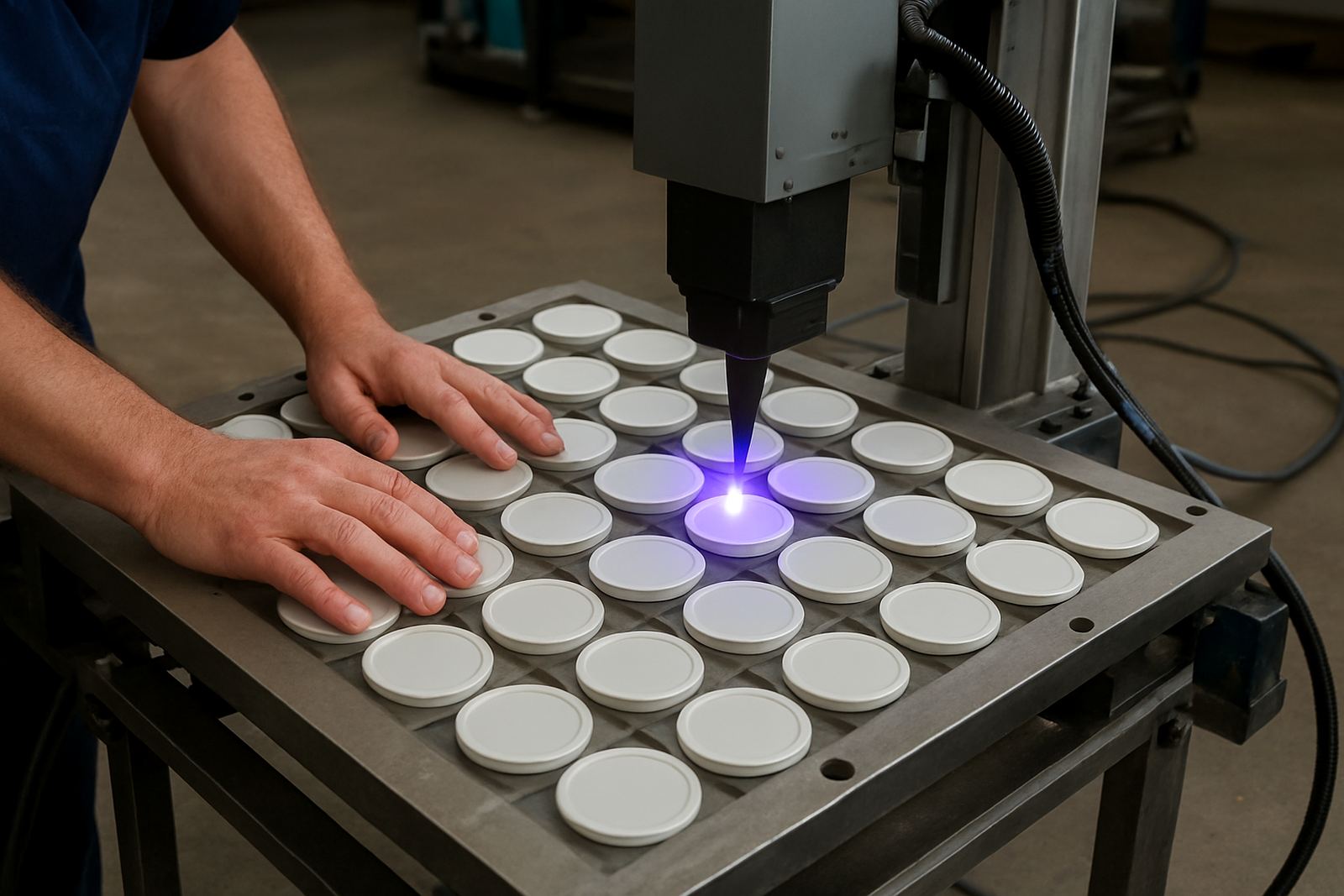
Fixture layout should match the shape, stiffness and feed pattern of the lid. A rigid plastic cap behaves differently to a thin foil or a broad flat closure. If the locating points are too tight, parts bind. If they are too loose, the marking height changes and the code quality drops.
A well-planned fixture supports throughput in three ways: it reduces manual handling, keeps the part face level and makes the infeed predictable. Even a few millimetres of poor presentation can slow the cycle if the machine has to pause for confirmation or if the operator needs to nudge parts back into place.
- Keep locating points simple so lids drop into place quickly.
- Allow enough clearance for wear, dust and small moulding variations.
- Use guides that stop rotation without scuffing the surface.
- Design for easy cleaning, especially on food and beverage lines.
Part presentation matters more than people expect
Part presentation means how the closure arrives at the marking point. A lid that lands flat and centred can be marked in a single motion. A lid that arrives skewed may need re-seatng, an extra pulse, or a full reject. On plastics, this is especially important because glossy surfaces can reflect light and show misalignment sooner than operators expect.
In practical terms, presentation is affected by the feed path, tray spacing, nest depth and transfer method. If a chute is too steep, lids pick up speed and bounce. If the nest is too shallow, they shift during marking. The best setup is usually the one that feels plain and predictable, not the one with the most moving parts.
- Check whether lids are arriving face up, face down or mixed.
- Measure the variance in part height before setting the focus.
- Watch for static cling on lightweight plastics in dry weather.
- Confirm that the transfer point does not crush or ovalise the part.
How speed and quality balance on real production lines
There is always a trade-off between running faster and holding quality. If the line is pushed beyond the fixture's ability to present parts consistently, the operator ends up clearing faults instead of producing usable output. That is why many plants test at a slower speed first, then increase gradually while watching the reject rate.
A sensible method is to look at three numbers together: cycle time, reject rate and operator intervention. If cycle time improves but rejects rise, the real output may be lower than before. The same applies when a line seems fast on paper but needs repeated resets after every few hundred parts. Actual productivity is the number of good parts leaving the station, not the speed setting alone.
What we look at during a site demo in Boksburg or Midrand
During a site demo, the first task is to see how the lids are arriving and how long it takes to settle them into position. We look at the fixture height, the loading method, the marking angle and whether the current layout suits the plant's available space. In some factories, a small change to the nest or guide rail is enough to free up a lot of time.
We also check the surrounding conditions. Dust, vibration and ambient heat can all affect how confidently a part stays put. In coastal areas the air can be more humid, while inland sites may deal with dry static that makes lightweight plastics cling together. Each site behaves differently, so the solution needs to fit the line not the other way round.
- Assess part flow from tray, hopper or conveyor.
- Check if the fixture allows quick loading during shift handover.
- Review access for cleaning and routine maintenance.
- Confirm that training covers both setup and fault finding.
Local example: a closure line that needed fewer stops
A packaging site in the Ekurhuleni area was coding plastic lids for a retail product and struggling with repeated pauses during the morning shift. The issue was not the marking process itself. The lids were arriving slightly rotated and the nest allowed them to sit at different heights. That meant the operator kept making small corrections before each run.
After the fixture was adjusted to better match the lid profile, the parts seated more consistently and the line ran with fewer interruptions. The team did not need a complicated change, just a cleaner way of presenting the closure to the marking point. Output became easier to plan and the supervisor could see the difference by the end of the week.
Keeping the line steady after install
Once the fixture is working, the job is to keep it working. That means checking wear points, cleaning residue, confirming alignment after maintenance and making sure operators know what a correct part looks like. On South African lines where shifts overlap and loadshedding can interrupt production, it helps to have a clear restart routine so the same setup is restored each time.
Good training matters here. If the team knows how to load the part, spot early drift and call for support before the rejects build up, the whole job becomes easier to manage. A well-set fixture gives the laser a stable target, and stable presentation usually means better speed without chasing faults.
For plants in Jet Park, Germiston, Benoni, Kempton Park, Alberton, Midrand and Pretoria, the same principle holds: the fastest line is the one that does not keep stopping to sort the next lid. That is where fixture layout earns its place.