When plastic lids need clean marks that stay put
Plastic lids are one of the trickier packaging parts to mark because the surface is often curved, light in colour and made from materials that can react badly to heat. On cup lids, bottle closures, tub tops and snap-on caps, a mark must be clear enough for traceability yet fine enough not to spoil the look of the pack. That is where UV laser marking is useful, because it produces a sharp mark with very little heat effect on the material.
For many South African packers the goal is simple: a readable code that survives friction, transport and chilled storage. In food plants around Jet Park, Boksburg, Germiston and Kempton Park, we often see lid marking linked to production batches, quality control and customer complaints. When the code is faint or poorly positioned, it causes extra checking and rework. A good marking setup reduces that pressure and keeps the line moving.
Common applications include brand logos, expiry dates, batch numbers, mould cavity references and short promotional text. The best result comes when the lid material, colour and surface finish are tested before installation, because what works on a white PP closure may not behave the same on a glossy transparent lid.
Typical UV laser setup for lids and closures
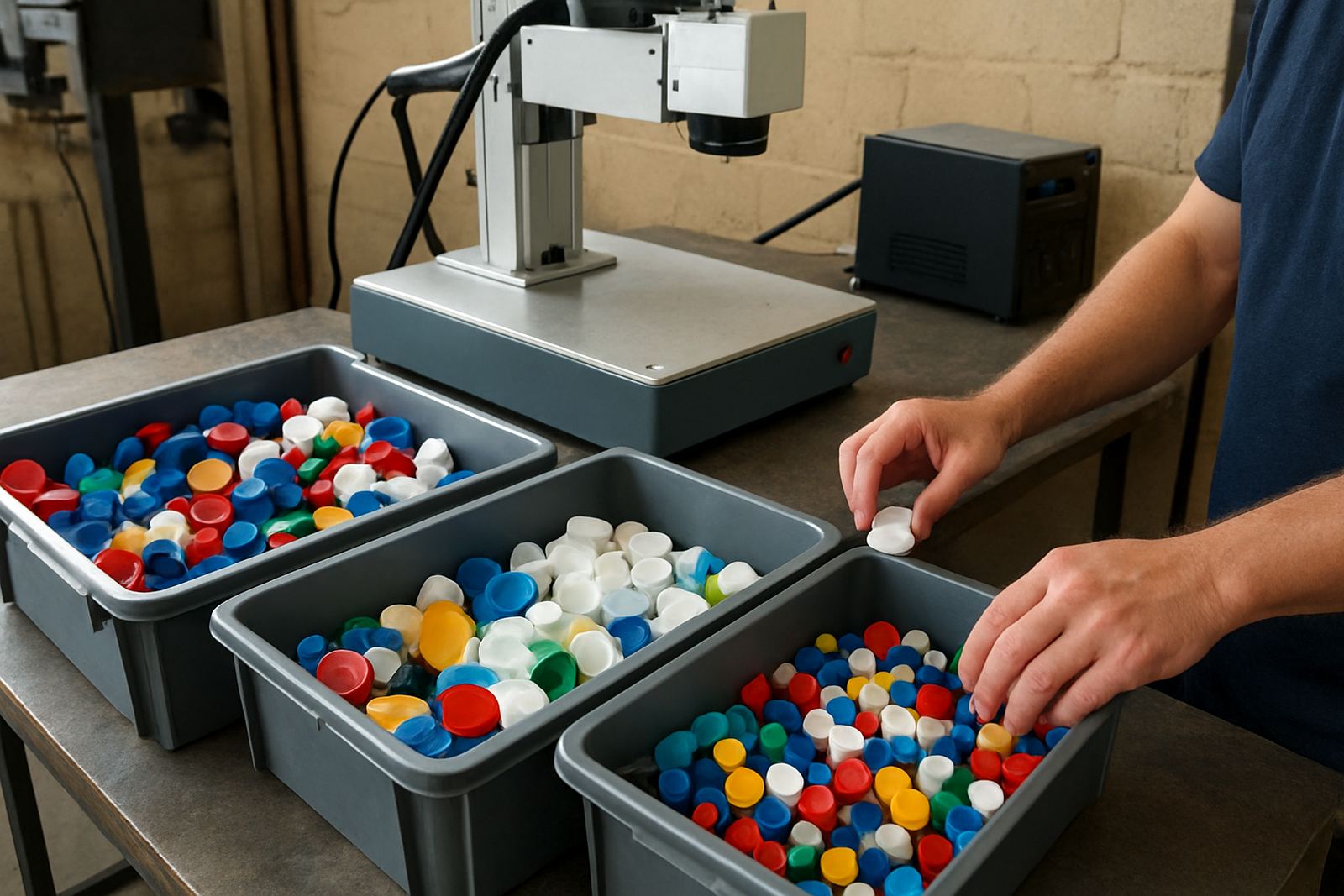
A lid marking station is usually built around a UV laser source, a stable mounting frame, a conveyor or indexing unit, and a fixture that holds each lid in the same position. If the lids are feeding in bulk, the system may need a bowl, escapement or singulation method to separate them before marking. For higher output lines, an inline setup is better than manual loading, especially where labour costs and consistency matter.
Depending on the product shape and line speed, the equipment set may include:
- UV laser marking unit sized to the required field
- Rotary or flatbed fixture for stable part location
- Vision or sensor control for presence checking
- Extraction for light fumes and dust
- Software for date change, code formats and logo files
- Protective guarding and interlocks for operator safety
For lids with a raised rim or domed centre, fixture design matters more than many buyers expect. If the part shifts by even a few millimetres, the code may land too close to the edge or ride over a texture. We normally test the exact lid sample, then set the optics, height and timing to suit the part geometry. That saves a lot of trouble later, and it avoids chasing marks that look fine on one sample but fail on the production run.
Planning the marking position before you buy
Good planning starts with the pack design, not the machine. The marking area on a lid is often limited by the mould, the snap fit and the artwork already printed on the pack. Before installation, the client should decide whether the mark must sit on the top face, the side skirt or a hidden area near the hinge or tab. On transparent and semi-clear plastics, contrast can also change depending on the angle of light in the warehouse.
It helps to bring a few samples to the demo and check these points:
- Exact lid material and colour
- How the lid is supplied, loose or stacked
- Required code size and character height
- Whether the mark must be human readable, machine readable or both
- The line speed and daily output target
- Any washdown, humidity or dust exposure on site
For coastal operations in places like Benoni, Alberton or Pretoria outlying industrial areas where storage conditions can vary, moisture and heat can affect handling more than the marking itself. The system should be positioned away from direct draughts, unstable tables and conveyor vibration. A small planning mistake at this stage can become an everyday irritation later on.
Common mistakes we see on lid marking projects
The first mistake is choosing a mark area that is too small. A code might fit on paper, but not on the real lid once the curvature and mould marks are taken into account. The second is assuming all plastics behave the same. A lid made from one polymer may mark nicely, while another version with additives, colourant or filler may need a different focus, slower speed or another pass.
Another issue is poor handling before marking. If lids arrive scratched, dusty or warped, the mark quality drops and the operator ends up adjusting the machine for a material problem rather than a marking problem. We also see clients place the unit too close to packing dust, compressed air blow-off or conveyor vibration. That can affect repeatability, especially on a long shift or during load-shedding when the line is started and stopped more than once.
Other avoidable errors include using the wrong code format, skipping sample testing, and not planning for future changes. If the product range may expand later, the system should be set up with enough flexibility to handle new lid sizes or new artwork files without major rework.
What the budget usually looks like
For plastic lids, the budget depends on output, the level of automation and the amount of handling needed. A basic semi-manual marking setup for samples or small runs may start around R180 000 to R350 000, depending on fixture work and software needs. A more complete inline system for regular production can sit between R450 000 and R900 000. More complex installations with vision checks, custom feeding and line integration can run above that, especially where the client needs high uptime and changeover control.
It is worth budgeting for more than the laser unit alone. Many projects need proper guarding, a custom mount, installation time, operator training and a few test runs before sign-off. If spares, software setup and preventive maintenance are included from the start, the total cost is easier to manage and the line is less likely to sit idle after a small fault. That is often where the real savings come in.
For plants in Ekurhuleni and across Gauteng, it also makes sense to plan for power stability and safe restart procedures. A well set-up unit should recover cleanly after an outage, but the surrounding process still needs checks for alignment and code verification.
How UV Laser supports lid marking projects nationwide
UV Laser works from Jet Park, Boksburg and supports clients in Germiston, Kempton Park, Benoni, Alberton, Midrand and Pretoria, with demos, installs and training nationwide. The team handles sample testing, fixture design, process optimisation, software setup and breakdown repairs, so the marking system is matched to the actual production environment rather than a generic specification.
The team members involved in a typical project include Riaan Pretorius on overall direction, Naledi Mokoena on operations, Refilwe Mahlangu on applications testing, Anele Dlamini on training, Priya Naidoo on service coordination and Thabo Khumalo on field installation. That mix helps when a client needs one-off sample work first, then a structured roll-out across a line or plant. We keep the discussion practical and focused on what the lid must do on the packing floor.
Clients usually start with an enquiry through the contact page, then send product samples for testing. From there the marked result, cycle time and positioning can be assessed before final equipment selection. It is a straightforward process, and it helps avoid buying a system that looks suitable on paper but struggles with the real lid shape on site.