What the Midrand team needed marked
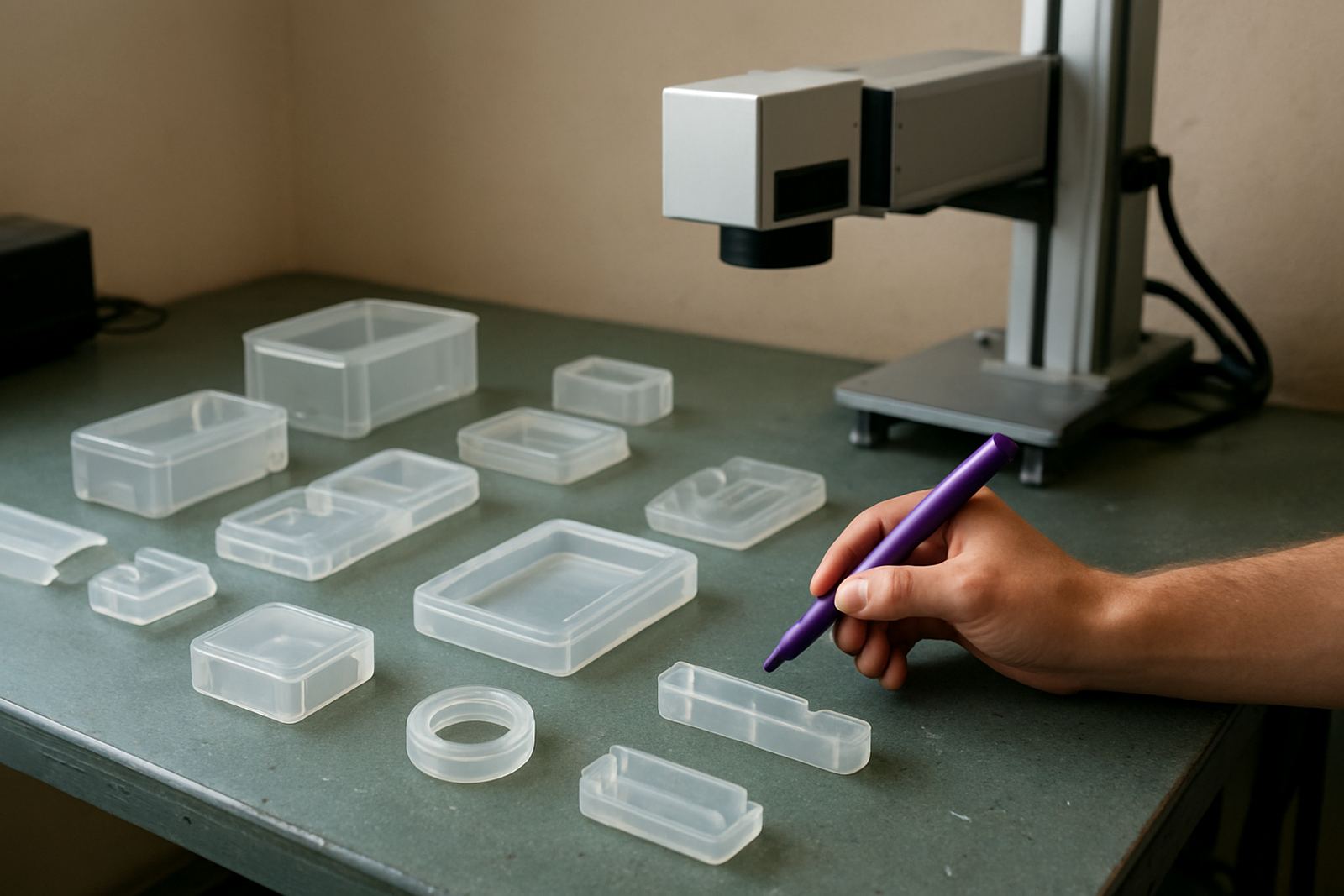
The client was an electronics parts supplier in Midrand handling small protective covers for internal components, inspection packs and shipping stages. The covers were translucent and lightly textured, so the brief was to add a permanent mark that stayed readable without cracking, whitening or warping the part.
The marks had to carry part numbers, batch codes and a small reference graphic for internal handling. Because the covers moved through packing, storage and repeated handling, the marking had to survive rubbing, cleaning and the usual workshop grime. They also wanted a clean finish that looked professional on parts going to local customers and export orders.
- Material: translucent plastic protective covers
- Mark content: part number, batch code and identification graphic
- Requirement: permanent, high contrast marking
- Site: Midrand, with support from our Jet Park base
Constraints on the production floor
The covers were thin and slightly flexible, so heat had to be kept under control. With some plastics, too much energy can leave a frosted patch or change the surface finish in a way that shows up immediately under light. The client also runs a busy packing area, so any marking method had to fit into a practical line speed, not slow everyone down.
Another constraint was consistency. The same code had to sit in the same position on every cover and remain legible against different levels of translucency. In Midrand, where many factories are operating under tighter power schedules and backup systems, the client wanted equipment that would restart cleanly after interruptions and still hold registration after a stop-start shift.
- Low heat marking to protect thin plastic covers
- Repeatable placement on every unit
- Readable output across varying translucency levels
- Suitable for interrupted power conditions and shift changes
The UV laser setup we supplied
We supplied a UV laser marking system set up for plastics with a focus on fine detail and controlled energy. The working field was sized for the client’s cover dimensions, and the marking programme was tuned to produce a neat, low-bleed contrast mark. We also prepared sample files for the main codes they use, so the operators could call up standard jobs without starting from scratch each time.
On site we checked the cover thickness, surface finish and the spacing needed for the mark. We then adjusted focus, power and speed in test cycles until the result was clear and repeatable. A small fixture was designed to keep the covers steady during marking, which helped with alignment and reduced handling. It also made the process easier for new operators after training.
- UV laser system tuned for plastic marking
- Custom job files for standard part references
- Simple fixture for location and repeatability
- Set-up adjusted for the actual cover finish and thickness
Testing, samples and sign-off
Before full production, we ran sample testing on different cover batches to confirm the mark stayed consistent across the material variations. We checked readability at a few angles because the covers are translucent and the mark needs to work under bright factory lighting as well as in boxed stock. The client wanted a mark that would not disappear when the part was stacked, moved or viewed through plastic film.
The testing stage took place over the first week, with a second round of adjustments after the client’s quality team reviewed sample pieces. Once the settings were approved, we locked the job parameters and issued a simple operating guide for the line. That let the team work with the same settings from shift to shift, which is important when you are dealing with regular order changes and mixed batches.
- Week 1: sample testing and material checks
- Week 2: adjustment of contrast and focus settings
- Sign-off after quality review of marked samples
- Operator guide issued for repeat use
Installation, training and line use in Midrand
Installation was completed in the second week and the line was handed over once the team was comfortable with the setup. Our field installation specialist worked with the operations team to place the machine in the most practical position on the floor, close enough to packaging but clear of traffic and stock movement. The final layout made it easier to load covers, mark them and move them on without extra lifting.
Training was done on site for operators and supervisors, with practical demonstrations on job selection, fixture loading, cleaning the lens area and checking mark quality. We also went through what to do after a power drop or a line restart, since that is a normal reality in Gauteng factories. By the end of training, the team could run standard jobs, check the first-off sample and keep production moving without waiting on outside help.
- On-site installation in Midrand
- Operator and supervisor training included
- Restart procedure covered for power interruptions
- Routine cleaning and quality checks explained
Results after rollout and what we would repeat
The result was a clean, permanent mark that stayed visible on the translucent covers without affecting the plastic surface. The client gained better traceability for internal stock and dispatch, and the finished look improved the presentation of the parts moving through their supply chain. They also found that the fixture reduced misalignment, which cut down on rejects and time spent reworking pieces.
Turnaround from first sample to live production ran over three weeks in total, including testing, fixture adjustments and final sign-off. If we were doing the same project again, we would repeat the early material testing and keep the fixture design simple from the start, because that makes a big difference once the line is running at pace. For this sort of cover, getting the settings right early saves time, waste and frustration later on.
- Better traceability on stock and dispatch
- Permanent identification without surface damage
- Lower reject risk through fixed positioning
- Practical handover for day-to-day production use
Key facts
| Client type | Electronics parts supplier |
|---|---|
| Location | Midrand, Gauteng |
| Material | Translucent protective plastic covers |
| Mark type | Permanent UV laser identification |
| Project duration | 3 weeks from sample testing to handover |
| Services used | Sample Testing, Fixture Design, Installation, Training, Process Optimisation |