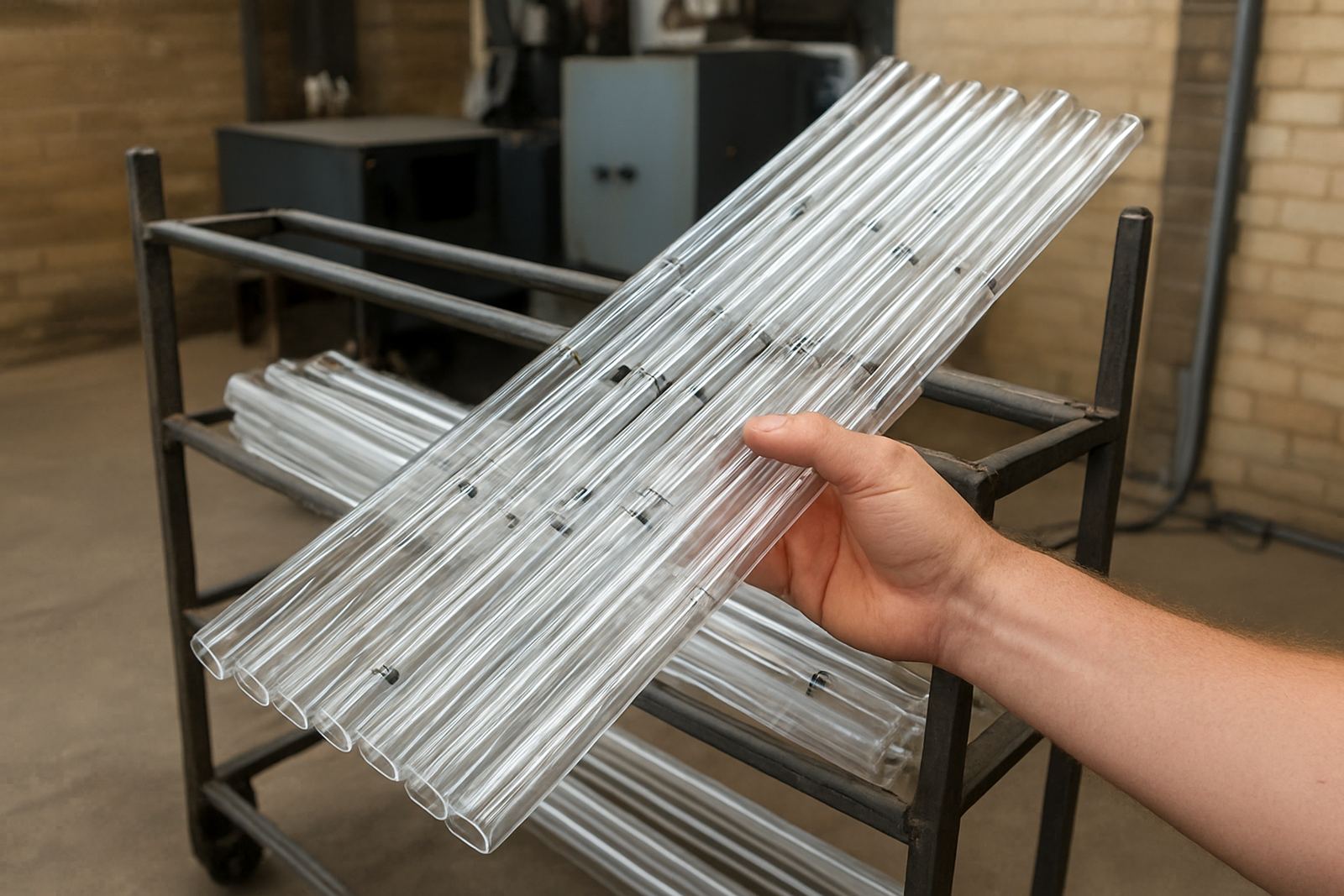
Why clear tubes need a different marking approach
Transparent tubes look simple but they can be difficult to mark well. Ink can bead on the surface, rub off during handling, or fade when the tube is exposed to cleaners, sunlight or heat. On a production line that is already dealing with load-shedding, short changeovers and staff doing more than one job, you need a marking method that stays consistent without constant touch-ups.
UV laser marking is a good fit for clear tube work because it creates fine, controlled contrast on plastics without heavy heat build-up. That matters on thin wall products, soft materials and smaller diameters where the wrong setting can leave haze, warping or a weak mark. For businesses in Gauteng, the coast and inland plants alike, it also helps when humidity and dust change how other marking methods behave.
Common applications include batch numbers, expiry dates, product IDs, brand names, dosage lines and short product descriptions. Some customers need a simple code, while others want a neat logo or a small repeating mark along the length of the tube. The key is to match the marking style to the material and the way the tube is packed, handled and stored.
Typical setup for clear tube coding and branding
The right equipment depends on tube size, line speed and how the product is presented to the machine. For clear tubes we usually look at the tube diameter, wall thickness, surface finish and whether the tube is moving individually or as part of a packed bundle. A stable fixture is often just as important as the laser unit itself.
- UV laser source matched to the plastic type and mark size
- Rotary or guided fixture for round tubes
- Simple infeed and outfeed supports to prevent rolling
- Control software for date, batch and variable data
- Extraction or cleaning measures where required by the material
- Safety enclosure or marked work area, depending on the site layout
For some sites in Jet Park, Boksburg or Germiston, the machine is used as a bench-top station for sample work and small runs. In other plants in Kempton Park, Benoni or Pretoria, the marking is built into a line with controlled spacing and repeatable positioning. The setup should suit your actual throughput, not just the ideal one on paper.
Planning the mark before installation starts
Clear tube marking is best planned around the final use of the product. If the tube is packed in a box, the mark must face the right way. If it is filled and capped before coding, the system must avoid damaging the contents. If the tube is very glossy, the contrast target may need a slight layout change so the mark reads clearly without looking heavy.
We normally test the tube first, then confirm the mark position, character size and cycle time. That lets the client see whether the result suits the pack style and whether the mark remains readable after normal handling. For branding jobs, it is worth checking how the logo sits on curved material at different angles, because a design that looks fine on screen may need spacing adjustments once it is wrapped around a tube.
- Confirm the plastic type before choosing settings
- Check if the tube will be empty, filled or sealed during marking
- Allow space for date codes, barcodes or small text
- Plan for line speed, not only sample speed
- Keep the mark position consistent for packing and inspection
Common mistakes on transparent plastic tubes
One of the biggest mistakes is using a marking method meant for cartons or labels and expecting it to work the same on clear plastic. Another is setting the mark too aggressively, which can leave a cloudy patch or slight distortion that becomes more obvious under inspection lights. Some operators also forget that round products move differently and need proper support during marking.
We also see cases where the client wants a mark that is too small for the tube diameter. On a narrow tube, tiny text may be technically possible but still hard to read in a warehouse or during dispatch. The better answer is usually a cleaner layout with fewer characters and stronger placement. If the tube is going through regular cleaning or is exposed to humidity, weak marks are often the first thing to fail.
Another common issue is poor changeover control. When multiple tube sizes are run on the same shift, the fixture, focus and software settings need to be stored properly. If not, the line spends too much time on reset work and the operator ends up guessing. That costs money and leads to mixed batches.
Budget ranges for clear tube marking in Rand
Budget depends on whether you need a sample station, a semi-automated fixture or a full line integration. For practical planning, most clients want to understand the first equipment cost, the installation cost and the ongoing support cost. It is better to budget properly up front than to add extras later because the first setup cannot keep pace with production.
As a rough guide, a simple sample testing setup can start from about R85 000 to R150 000, depending on the marking size and the fixtures needed. A more complete bench or semi-automated system often sits in the R180 000 to R450 000 range. Full line integration with controls, installation, training and site-specific fixtures can move from around R450 000 upwards, depending on the tube format and throughput.
Ongoing costs are usually lower than people expect, but they still matter. Allow for preventive maintenance, spare parts, occasional software setup changes and operator refresher training. If the site runs on a tight production window, breakdown cover and spare supply planning can save a lot of downtime later on.
What we check during demos, installs and training
For clear tubes, a proper demo should show how the mark looks on the actual product, not only on a sample piece. We check readability, repeatability, focus stability and how the tube behaves under normal handling. If the customer is based in Midrand, Alberton or farther out in Pretoria or the East Rand, the same approach applies: test the real item first and work from there.
Our team can assist with site demos, sample testing, machine installation, operator training, fixture design, line integration, preventive maintenance, breakdown repairs, software setup, process optimisation, spares supply and nationwide support. Riaan Pretorius oversees the business, with support from Naledi Mokoena, Refilwe Mahlangu, Anele Dlamini, Priya Naidoo and Thabo Khumalo, so the work is handled from first test to handover.
That matters when the customer needs clear tubes marked consistently across multiple shifts or sites. The aim is not only a neat sample, but a setup the team can run properly on a normal weekday when the line is busy and the pressure is on.