When a small vial must carry more than a label can hold
Glass vials are usually short on space and unforgiving on finish. You may need a batch code, expiry detail, client logo, a serial number or a simple identification mark, all on a narrow body or near a shoulder that curves away from the beam. In those cases, a UV laser is often the cleanest option because it marks without inks, solvents or consumables that can smudge, lift or fade.
This is common where vials are handled in clean areas, packed in trays, or shipped through long supply chains where the mark must still be readable when it arrives in Durban, Gqeberha or Cape Town. Many clients also need the mark to hold up to alcohol wipe-downs, refrigeration, and the day to day handling that happens in a busy plant. A good setup gives you repeatable results and less rework.
For glass vials, the goal is usually not a deep engraving. It is a controlled surface mark with clean edges and enough contrast to read at speed. That matters when operators are checking fill lines, QC teams are tracing batches, and the customer wants a neat finish on something only a few millimetres wide.
Typical UV laser set-up for vial marking lines
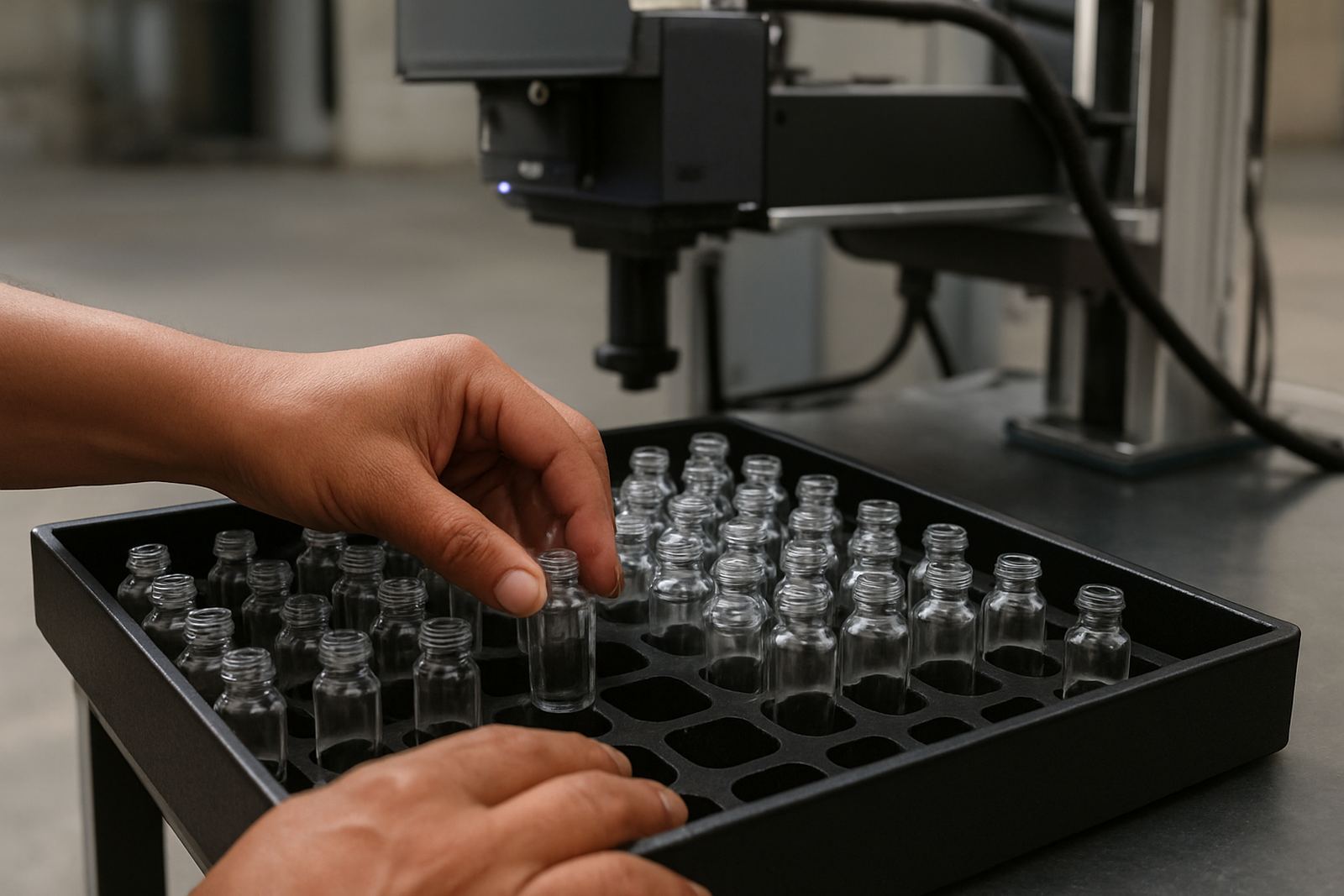
The right set-up depends on vial size, glass thickness, line speed and how the vials are presented to the machine. Some clients bring vials in as loose pieces for sample testing, while others need a fully integrated line with infeed, marking, rejection and collection. We usually start by looking at the actual vial, the cap or closure, and the area available for the mark.
A typical system for glass vials may include a UV laser source, a scanning head, a stable work surface or conveyor, a fixture to hold the vials in position, and software for code changes and job recall. On production lines, we often look at height adjustment, guarding, and the way the vials move through the marking zone so that the beam stays consistent even when operators are changing over formats.
- Loose vial sample testing for mark quality and readability
- Single-station fixtures for short runs or special batches
- Conveyor-based marking for higher throughput lines
- Camera or verification options where traceability is critical
- Extraction or enclosure planning for safe, tidy operation
In Jet Park and the wider Ekurhuleni area, many clients want a compact footprint because floor space is tight. If the line is going into a chilled room or a plant with dust and humidity, that should be planned early. Coastal moisture, temperature swings and load-shedding all affect how equipment is housed and powered.
Planning the layout so the mark stays consistent
Good results start before the first vial goes under the beam. We look at vial diameter, wall thickness, glass finish, line speed, and how much movement is acceptable at the point of mark. If the vial rolls or sits slightly off centre, the code can drift. If the glass varies from batch to batch, the settings may need small adjustments to keep the mark crisp.
Placement matters too. Some clients want the mark on the base, others on the body, and some need it aligned with printed artwork or a printed label. A proper layout should leave enough room for batch information without crowding the vial. When the vial is very small, even a few millimetres can make the difference between a legible code and a mark that is hard to read under fluorescent lighting.
- Check the maximum and minimum vial dimensions first
- Set a repeatable stop or fixture point
- Allow access for cleaning and changeovers
- Plan power backup if the line cannot stop during outages
- Confirm how the mark will be read by operators or scanners
We also advise clients to think about future SKUs. If the same line may later run different vial heights or closure types, the fixture and software should allow that change without major downtime. A small bit of planning now can save a lot of frustration later.
Common mistakes that cost time and product
One common mistake is choosing a marking method that looks fine on paper but is too harsh for the vial. On thin glass, too much energy can leave a poor finish. Too little energy gives a mark that disappears under glare. Another issue is trying to mark on a curved area without testing the angle and focus first. Glass vials are small, and small errors show up quickly.
Another frequent problem is overlooking handling. If the vial is moving too fast, wobbling in the fixture or touching other glass pieces, the marking quality drops. Dirty surfaces can also affect contrast, especially where dust, condensation or fingerprints are present. In some plants, operators also forget that the mark needs to survive sterilising steps or cold storage, not just the first inspection.
Before production starts, it helps to avoid these mistakes:
- Skipping sample tests on the actual vial material
- Using a fixture that does not hold the vial square
- Ignoring line speed and dwell time
- Setting the mark too close to the neck or shoulder
- Leaving no plan for power cuts or restart checks
For clients in Germiston, Benoni, Alberton or Pretoria, we often recommend a proper site demo first. That way the team can see the mark, check the handling, and confirm the operator workflow before any installation goes in.
Budget ranges for glass vial marking projects
Budget depends on whether you need a simple marking station, a semi-automatic fixture, or a line-integrated system with controls and verification. For smaller vial projects, a practical starting point can be around R180 000 to R350 000 for a basic system with testing, set-up and training. More involved installations with line integration, custom fixtures, software setup and extra handling equipment can move into the R400 000 to R850 000 range, depending on the throughput and site requirements.
If you need a custom solution for a pharmaceutical or laboratory environment, costs can rise further once enclosure work, guarding, automated loading, or rejection devices are added. The best way to keep the budget under control is to test the actual vial, agree the marking area early, and decide whether the line needs full automation or a simpler operator-fed station. That choice makes a big difference to the final Rand figure.
We also help clients plan for spares, preventive maintenance and operator training, so the system does not sit idle when a part needs replacing or a new staff member joins. In South Africa, that matters as much as the original machine price.
How we support vial marking from demo to production
Our team handles site demos, sample testing, machine installation, operator training, fixture design, line integration, preventive maintenance, breakdown repairs, software set-up, process optimisation and spares supply. Work is handled from Jet Park, Boksburg, with support across Ekurhuleni and nationwide. That includes sites in Midrand and Pretoria as well as production facilities in and around the East Rand.
For glass vials, we usually start with a sample run and a short discussion about production targets, available space and the type of mark needed. From there, Refilwe and the applications team can test settings, while Thabo assists with installation and line fitment. Riaan oversees the technical direction, and the support team makes sure the handover is practical for the people who will use it every day.
If your operation needs fine marking on glass vials, the main aim is simple: a clean mark that stays readable, fits the line and holds up in real working conditions. The right set-up should make life easier for the production team, not add another step to their shift.