Premium bottle branding for a fast moving Germiston line
The client is a packaging operation in Germiston that fills and finishes premium glass bottles for retail and gifting ranges. They wanted a marking method that could carry batch details, product identifiers and brand artwork on the bottle body without labels lifting in cold rooms or scuffing during handling. Their existing process was giving inconsistent results, especially where the glass finish and curvature made ordinary marking methods less reliable.
The brief was simple on paper and a bit more demanding on the floor. Mark the bottle cleanly, keep the finish permanent, and do it at line speed without adding messy consumables or slowing changeovers. The bottles were moving through wash, fill and pack areas, so the marking point had to suit real production conditions, not just a sample on a bench. We also had to make sure the marks stayed readable under bright retail lighting and after normal crate handling.
Because the site works with product runs that change through the week, the client needed a setup that could handle multiple SKUs and short runs without constant re-setting. The bottle range included clear and tinted glass, and the artwork needed enough contrast to stay legible. In practical terms, that meant the marking head, rotary fixture and software settings all had to be matched properly before the client went live.
What made the project tricky on the production floor
Glass is unforgiving if the setup is off by even a small amount. Bottle curvature, wall thickness and surface finish all affect how a UV mark appears, so we first tested the client’s sample bottles under different marking positions and speeds. We also checked for any distortion from the rotation angle because a mark that looks fine on one side of the bottle can soften or shift on another side if the fixture is not aligned.
There were a few site constraints to work around. The line had limited space near the marking point, and the client did not want unnecessary changes to the existing conveyor layout. There was also the usual South African reality of load-shedding, so the equipment and control setup needed to recover properly after power interruptions. On top of that, the packing area gets warm and dusty during busy shifts, so we kept the installation practical and easy to maintain.
Another point was repeatability. The client wanted the same result from the first bottle to the last, even when operators changed during the week. That meant clear software settings, straightforward job recall and training that would let the team run the machine without relying on one person. Small setup errors can waste product fast, especially on premium glass, so consistency was a major part of the brief.
- Glass bottle diameters varied between product lines, so fixture flexibility was important.
- The mark had to remain permanent through handling, wiping and display packing.
- Changeovers needed to be quick enough for short production runs.
- Operators had to be trained to set up the jobs correctly every time.
Rotary UV marking setup supplied and installed
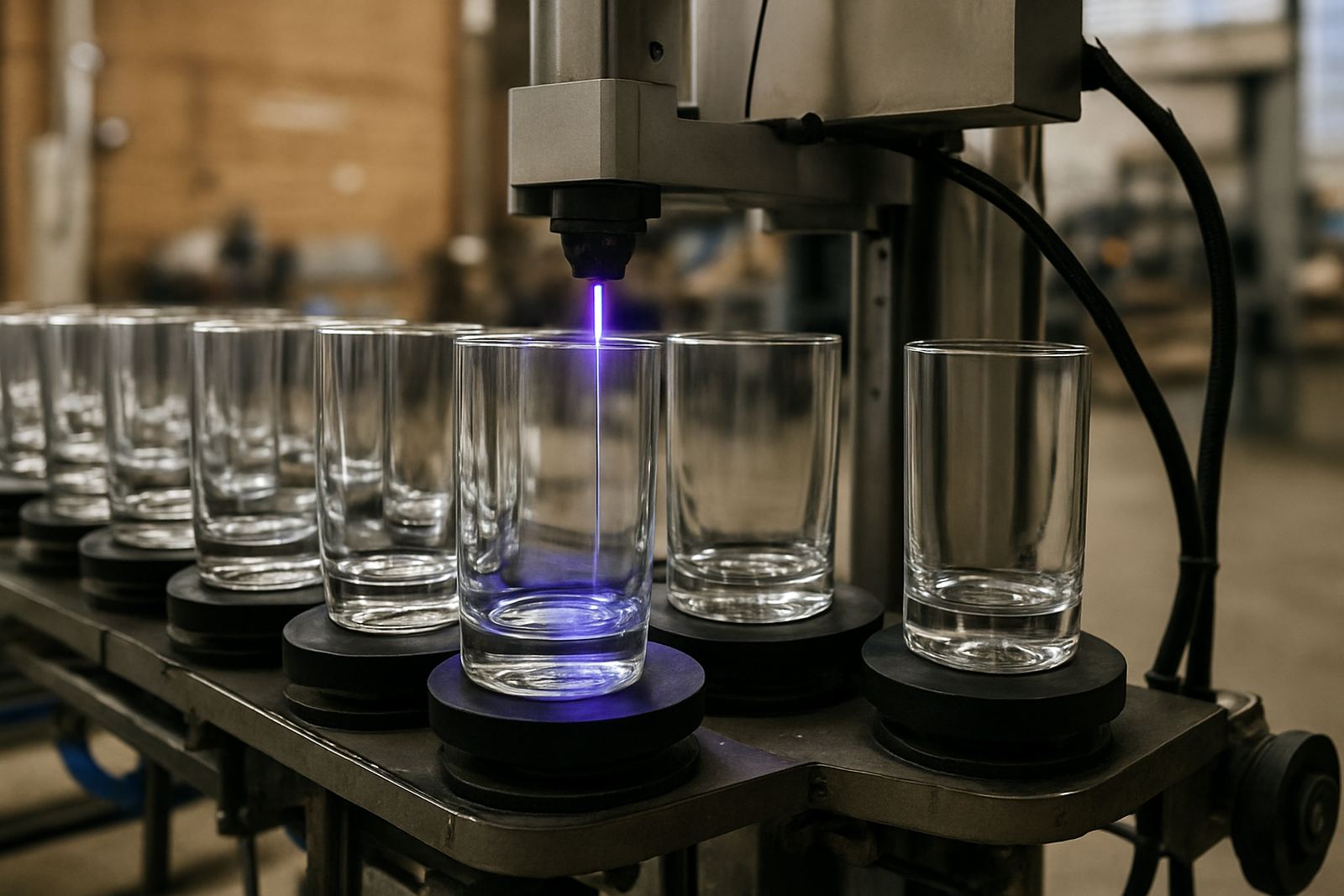
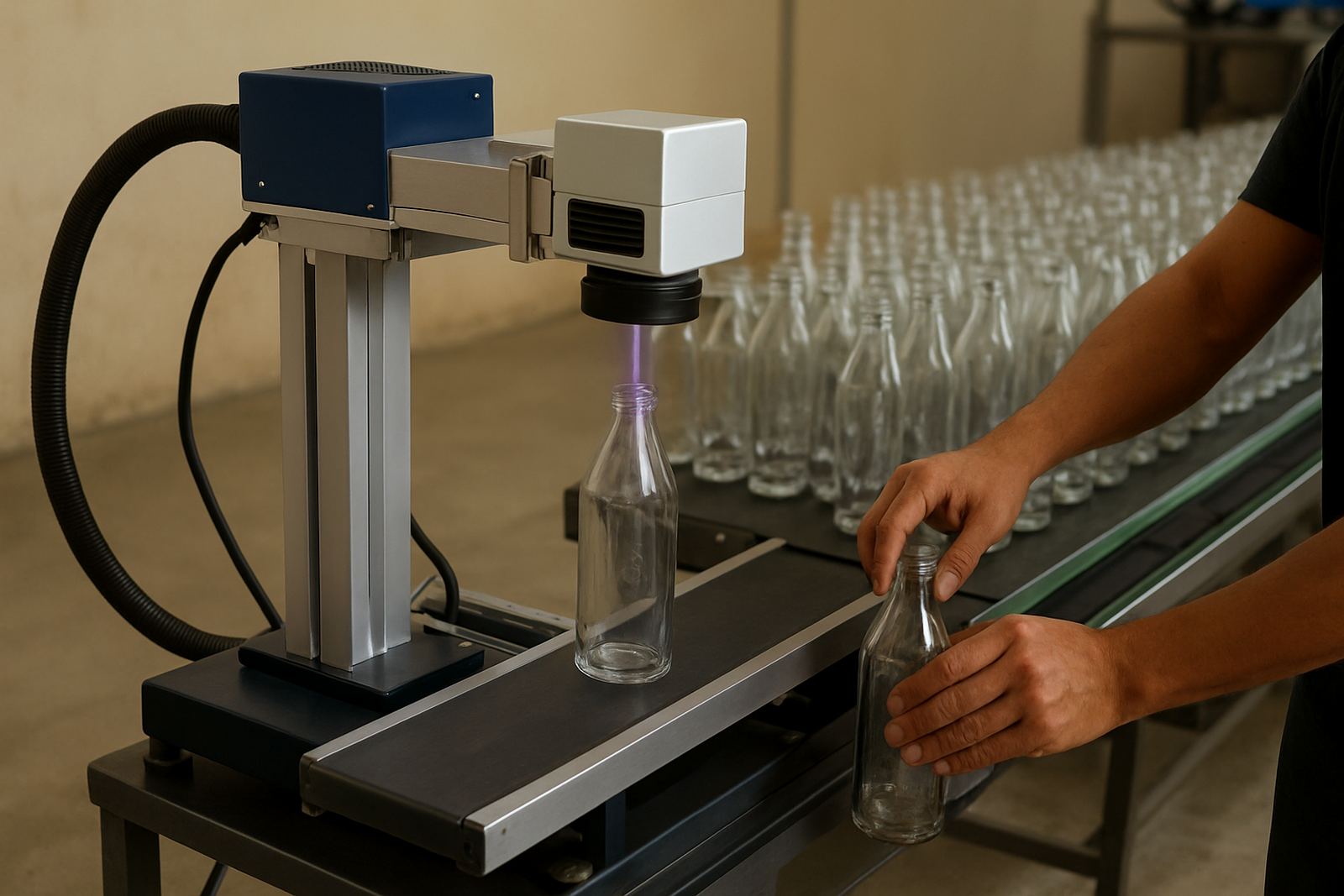
We supplied a rotary UV marking solution set up for glass bottle branding and variable product information. The system was configured for clean, high-contrast marking on curved surfaces, with the rotary motion keeping each bottle steady while the laser worked across the target area. That gave the client a more controlled result than a flat-surface approach and removed the need for secondary labelling on selected ranges.
The installation included the marking machine, bottle positioning fixtures, software setup, and line-side commissioning. We also assisted with sample testing before final sign-off, using the client’s own bottles to confirm mark size, placement and speed. The final job settings were saved for the main product ranges so the team could call them up again with minimal fuss. It was a neat setup, nothing over-complicated, and that was the point.
We handled the physical install in Germiston and then spent time on the software side to make sure the operators could manage artwork, batch data and job recall with confidence. Refilwe Mahlangu led the application testing, while Thabo Khumalo handled the field installation and alignment at the line. Naledi Mokoena coordinated the schedule so the client could keep production moving, and Priya Naidoo handled the admin side of the project and follow up.
- Rotary marking for curved glass bottles
- Permanent UV marks for branding and batch identification
- Operator-friendly software setup with saved job parameters
- Fixture adjustment for different bottle sizes
Timeline from sample test to live production
The full project ran over three weeks from first contact to handover. Week one covered sample collection, brief confirmation and initial testing in Jet Park. We checked mark quality on the actual bottles, then refined the position and cycle time to match the client’s line speed. Week two was used for fixture finalisation and preparing the machine for site installation. Week three covered delivery to Germiston, installation, commissioning and operator training.
The client wanted minimal downtime, so we arranged the site work around their production schedule. That meant doing the heavy setup work first, then the final alignment and testing once the line was ready. We also made sure the team had clear startup and shutdown steps in place, which matters when power cuts or shift changes interrupt a run. A few minutes of planning saved a lot of rework later.
During training, we showed the operators how to check focus, confirm bottle placement and run the saved programmes for the main product types. We also covered what to look for if the mark starts to fade or shift, so minor issues can be spotted early. The client appreciated that the process did not need fancy handling, just sensible control and steady setup.
Results on bottle clarity, consistency and turnaround
Once live, the project delivered what the client needed most: clear marks that stayed legible on premium glass and did not wear off in normal handling. The marking quality improved across the range, and the team no longer had to fight with labels or rework caused by inconsistent print. The final result suited the look of the product as well, which matters when the bottle itself is part of the brand presentation.
We also saw a practical gain in turnaround. Because the job settings were stored and the fixture was built for the bottle range, changeovers became faster and the line team could move between products with less stoppage. The client could run smaller batches without worrying that setup time would eat into the shift. That is a real benefit in packaging, where a short run can still carry as much admin as a larger one.
The client was particularly happy with the way the marks held up during packing and transport. No smudging, no peeling and no need for added labelling on the marked products. For premium bottles, that makes a difference at the shelf and in the warehouse. It also gave the team a neater process overall, with less waste from poor marking.
- Sharper, permanent bottle branding
- More consistent results across clear and tinted glass
- Faster product changeovers
- Less rework and fewer rejected bottles
What we would repeat on the next glass bottle line
If we were doing this again on another glass bottle line, we would still start with live sample testing on the client’s own containers. That is the quickest way to confirm mark quality, bottle rotation and speed before anything is installed. We would also keep the fixture design as simple as possible, because the easiest setups are usually the ones that keep running long after the site visit is finished.
For a similar packaging client, we would recommend a short pre-install review of bottle sizes, line speed and space around the marking point, then a clean handover with saved settings for each product family. That saves time later and keeps the operators comfortable with the machine. It is also worth building in preventive maintenance from day one, especially where dust, heat and load-shedding can interrupt normal production. A bit of care up front goes a long way.
This Germiston project showed how well rotary UV marking suits premium glass bottles when the brief is clear and the sample testing is done properly. The result was neat, durable and practical for day-to-day production, which is exactly what the client needed.
Key facts
| Project location | Germiston, Ekurhuleni |
|---|---|
| Client type | Packaging operation for premium glass bottles |
| Marking method | Rotary UV laser marking |
| Main use | Branding, batch details and product identification |
| Timeline | 3 weeks from sample test to handover |
| Scope | Sample testing, installation, training and line commissioning |